
Peace, Prosperity, and Human Empowerment
Sustainable Development
Peace, Prosperity, and Human Empowerment
Sustainable Development
Peace, Prosperity, and Human Empowerment
Sustainable Development
Peace, Prosperity, and Human Empowerment
Sustainable Development
The MQI Sustainable Development Goals represent a comprehensive framework for global peace, progress, and prosperity—rooted in the visionary leadership of Shaykh-ul-Islam Dr. Muhammad Tahir-ul-Qadri and the mission of Minhaj-ul-Quran International since 1980.
A Vision for Peace, Prosperity, and Human Empowerment
The Minhaj-ul-Quran International Sustainable Development Goals (MQI-SDGs) present a comprehensive framework for global peace, progress, and prosperity—rooted in the visionary leadership of Shaykh-ul-Islam Dr. Muhammad Tahir-ul-Qadri and the mission of Minhaj-ul-Quran International (MQI) since its founding in 1980.
The MQI-SDGs embody a universal call to action—inviting individuals, communities, and institutions to work together for a peaceful, just, and compassionate world.
At the heart of MQI's philosophy lies the conviction that true sustainable development transcends material progress—it must integrate spiritual, ethical, and social well-being. Inspired by the timeless values of the Qur'an and the Prophetic model of mercy, justice, and balance, the MQI-SDGs aim to eradicate poverty and ignorance, empower people through knowledge and equality, uphold justice and peace, and protect the environment as a sacred trust.
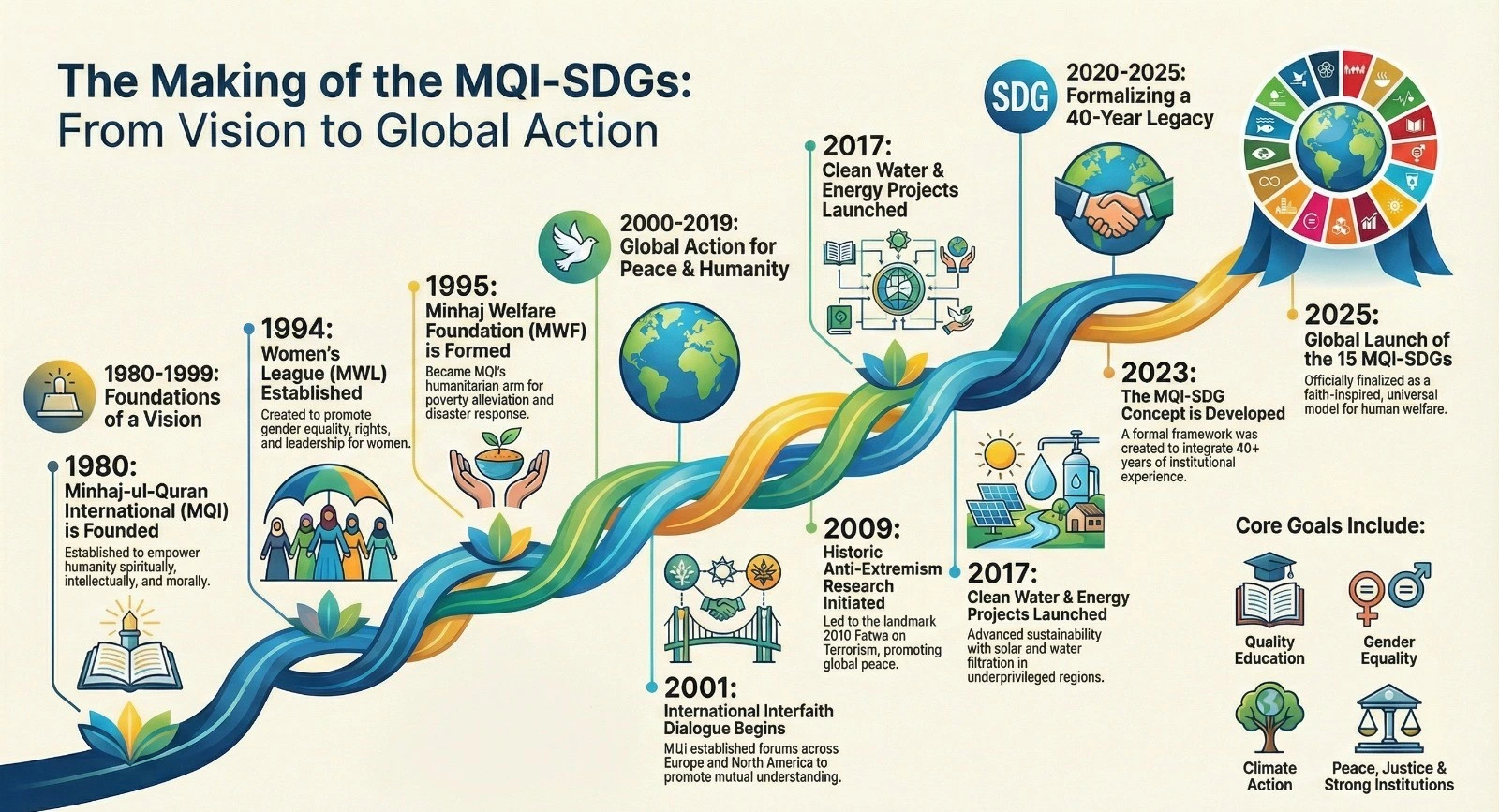
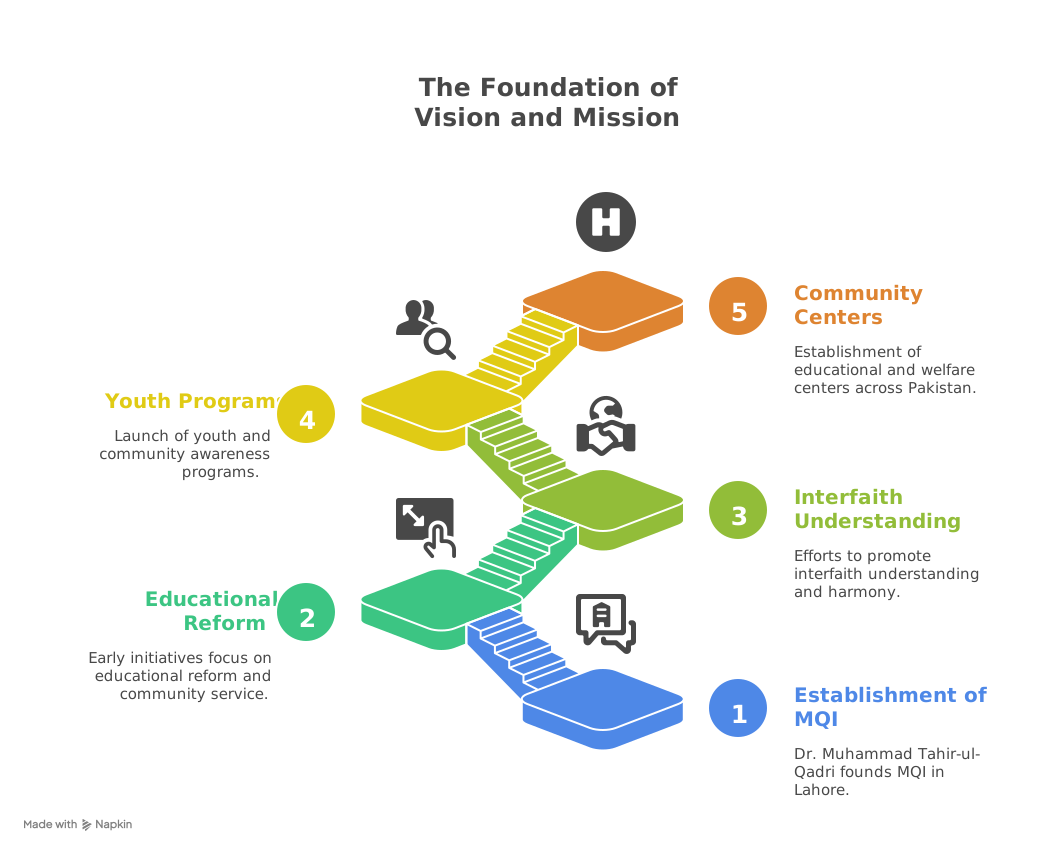
1980 – Establishment of Minhaj-ul-Quran International (MQI)
Dr. Muhammad Tahir-ul-Qadri founded MQI in Lahore with the mission to spiritually, intellectually, and morally empower humanity.
Early initiatives emphasized educational reform, community service, and interfaith understanding, marking the beginning of a lifelong struggle against ignorance and inequality.
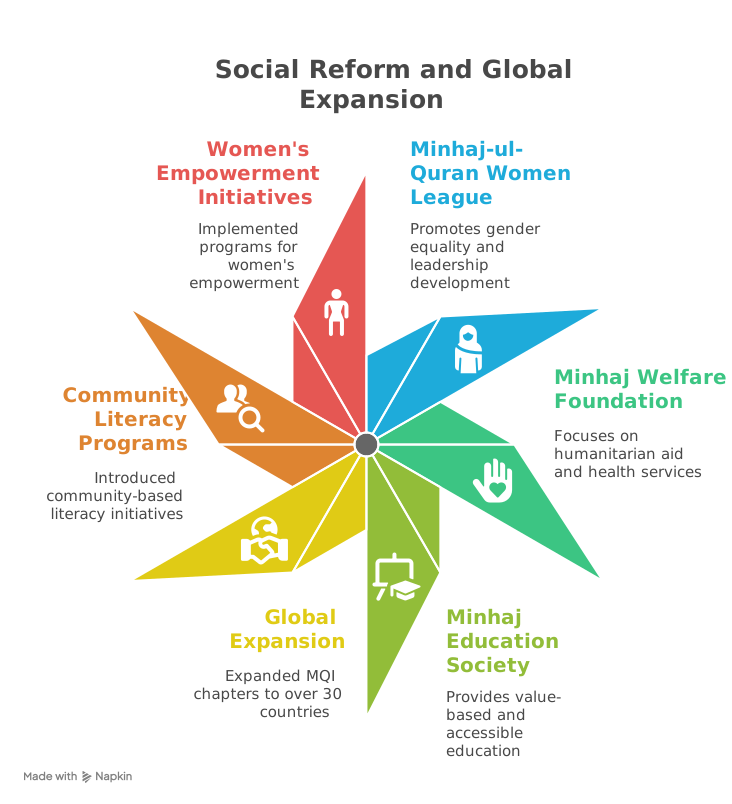
1994 – Establishment of Minhaj-ul-Quran Women League (MWL)
Recognizing women as essential partners in nation-building, MQI founded MWL to promote gender equality, awareness of rights, and leadership development among women.
1995 – Formation of Minhaj Welfare Foundation (MWF)
MWF became MQI's humanitarian arm, focusing on poverty alleviation, disaster response, and health services in Pakistan and abroad.
1998 – Inception of Minhaj Education Society (MES)
A nationwide network of schools and colleges was launched to provide modern, value-based, and accessible education—laying the foundation for Quality Education for All.
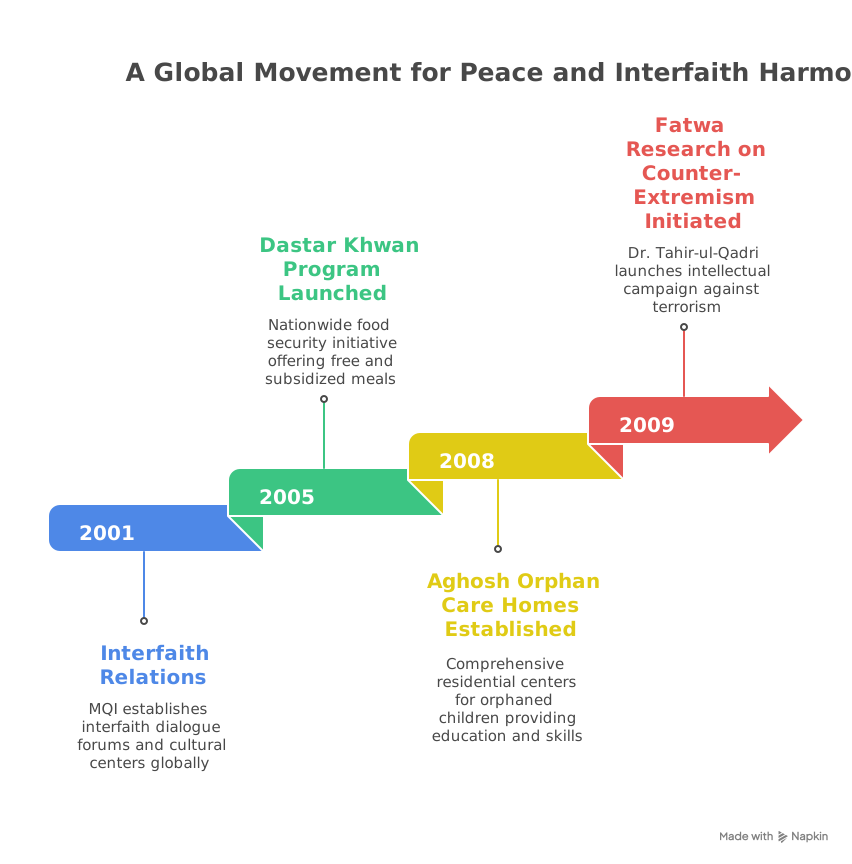
2001 – Beginning of International Outreach
MQI established interfaith dialogue forums and cultural centers across Europe, North America, and the Middle East, promoting mutual understanding among religions.
2005 – Launch of "Dastar Khwan" Program
A nationwide food security initiative offering free and subsidized meals to low-income families—an early step toward SDG 2: Zero Hunger.
2008 – Establishment of Aghosh Orphan Care Homes
Comprehensive residential centers for orphaned children providing education, skills development, and career counseling—embodying SDG 1: No Poverty.
2009 – Initiation of Fatwa Research on Counter-Extremism
Dr. Tahir-ul-Qadri launched a historic intellectual campaign against terrorism, culminating in the 2010 Fatwa on Terrorism and Suicide Bombings—a milestone in promoting peace and countering extremism worldwide.
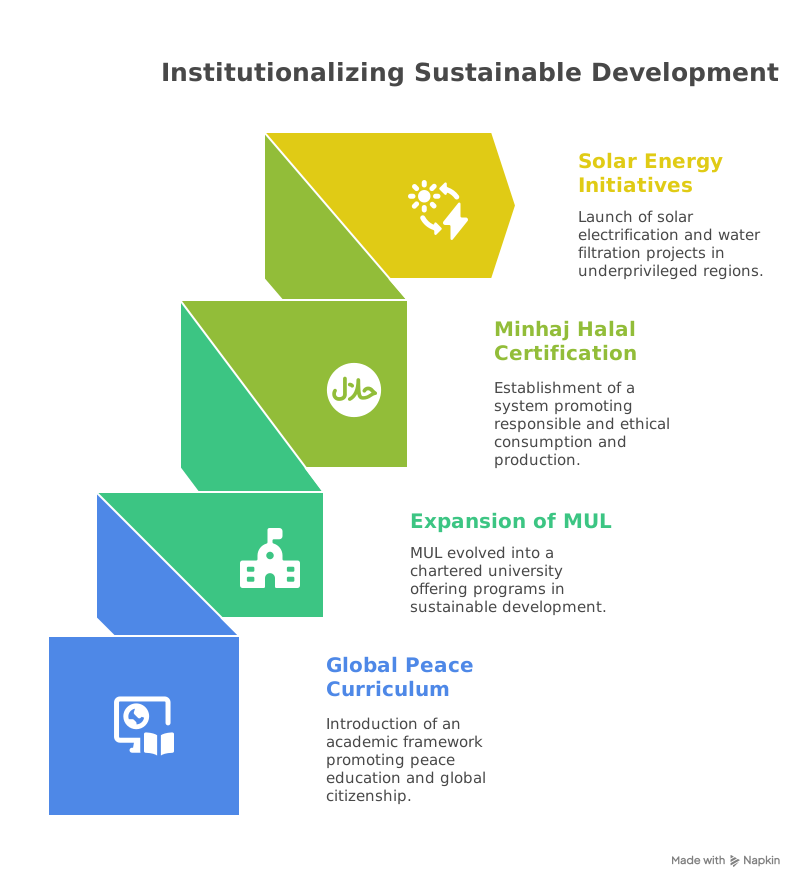
2010 – Launch of the Global Peace Curriculum
Dr. Qadri introduced an academic framework promoting peace education, counter-radicalization, and global citizenship values.
2012 – Expansion of Minhaj University Lahore (MUL)
MUL evolved into a chartered university offering programs in sustainable development, peace studies, and ethical governance.
2014 – Establishment of Minhaj Halal Certification (MHC)
A system promoting responsible and ethical consumption and production—contributing directly to SDG 12: Responsible Consumption and Production.
2017 – Solar Energy and Clean Water Initiatives
MWF launched solar electrification and water filtration projects in underprivileged regions—advancing SDG 6 (Clean Water and Sanitation) and SDG 7 (Affordable and Clean Energy).
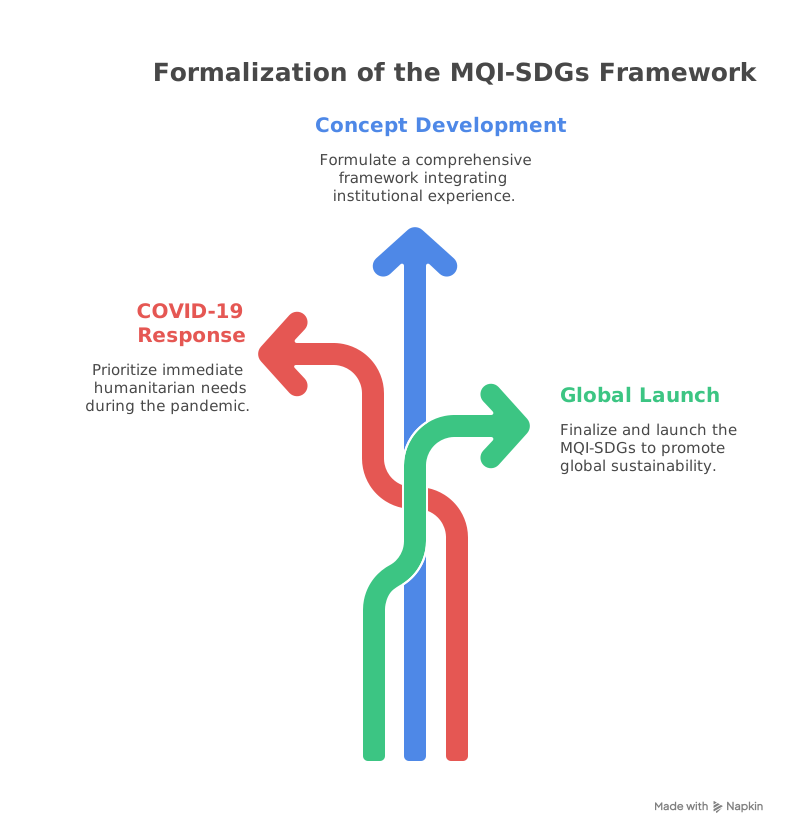
2020 – COVID-19 Humanitarian Response
MQI conducted large-scale relief operations, delivering medical assistance, food, and financial support to families impacted by the pandemic.
2023 – Development of the MQI-SDGs Concept
MQI leadership initiated the formulation of a comprehensive framework integrating over 40 years of institutional experience into 15 thematic Sustainable Development Goals.
2025 – Finalization and Global Launch of MQI-SDGs
The MQI-SDGs were officially finalized—encompassing social, economic, environmental, and spiritual dimensions of sustainability. They represent a faith-inspired yet universally inclusive model for human welfare and global peace.
The MQI-SDG framework operates through a network of specialized bodies working together for global peace and sustainable development.
Minhaj Welfare Foundation
Humanitarian aid and development
Women League
Gender equity and social justice
Youth League
Youth leadership and civic engagement
Interfaith Relations
Dialogue and coexistence among faiths
Internet Bureau
Digital outreach and awareness
Education & University
Quality education and research excellence

Broadcasting

Media Content
Books & Journals

Digital Outreach
Progress Tracking
Today, the 15 MQI Sustainable Development Goals stand as the living continuation of Dr. Tahir-ul-Qadri's four-decade-long mission—to restore moral values, empower humanity, and build a peaceful world grounded in divine compassion. Together, the Minhaj-ul-Quran Sustainable Development Goals illuminate a transformative path—where knowledge strengthens faith, compassion drives progress, and peace becomes the foundation of global prosperity.


